
About
/
↑ PHOTO CREDIT: Tom fitzgerald
Holding Space | Summer 2025
"Any amount of consciousness that you can apply to your pain is a great fortune, even when it means being in closer proximity with your sorrow. We need to be able to name it in order to heal it."
– Chani Nicholas
I used to be a “"wake up to NPR” person. For some time now, I’ve enjoyed the privilege of starting my day without the weight of the news pressing in. Protecting my peace is useful, but it comes at a cost—sometimes I’m late to the stories that shape the lives of the people around me.
A few weeks ago, that cost hit me. I had just returned from Minneapolis, full of energy from a conference and the friends that I had met up with. I sent a joyful thank-you text to one of them, only to learn later of the horrific church shooting that had happened hours earlier. I reached back out. She told me folks were grieving. It had already been a rough summer. This tragedy was simply the one that broke through to the national headlines.
While in town, I stayed mostly in the conference hotel. Outside of meals and brief walks, I was removed from the city and its context. And yet, ironically, it was that very absence that struck me as I flew home. The view of the earth from the sky has always filled me with wonder. Quilted fields of green and brown. Dense clusters of silver and gray grids. Shadows of clouds drifting slowly across it all. But on this flight, I was keenly aware that my view showed only the traces of human presence. I could not see the people who lived their lives amid the landscape. I felt a longing to connect, to bridge the distance.
And yet, bridging that distance can often mean attuning to pain.
Gaza. South Sudan. Ukraine. Congo. Minneapolis. These and other places quilt themselves into a list that keeps growing. A patchwork of grief across our global landscape. As summer fades, the litany of losses does not.
For some, the pain has stretched across years, not months. And as more of us attune to its depth, grief feels incessant. A few months ago, I wrote about the practice of noticing and engaging with what is—even when what is feels unbearable. But proximity to sorrow brings heartbreak. Helplessness. At times, even guilt. How do we carry all of that?
After the election in November, I reflected on the truth that comes when we speak our grief out loud. Perhaps we have reached this point precisely because there has never been enough space for many of us to do so. There are no easy answers, no quick fixes. And yet, as the aftermath of the COVID pandemic showed, we live in a culture conditioned to look away, to run from both individual and collective pain. I’ve spent years working in communities where grief went unspoken; one truth has consistently held: when we push grief into the shadows, we make room for more harm to take root and grow.
We each carry our own ways of being present in this moment: marching in the streets, giving or sharing resources, engaging online, gathering at vigils. Alongside those actions, I hope we keep making room for grief—naming it, reckoning with its origins, tending to it, and supporting one another in carrying it.
Too often, grief is confused with despair. But they are not the same. Despair leaves us stuck in hopelessness; grief gives us agency to move through pain. Grieving isn’t easy. It doesn’t instantly stop the harm, nor heal every wound. But it nourishes the soil where repair can take root. If we are to break the cycle of harm, if we are to mend the landscapes of loss, this is where it must begin.
Take good care,
Liz Ogbu
Designer, Spatial Justice Activist, Grief Worker
Founder + Principal, Studio O
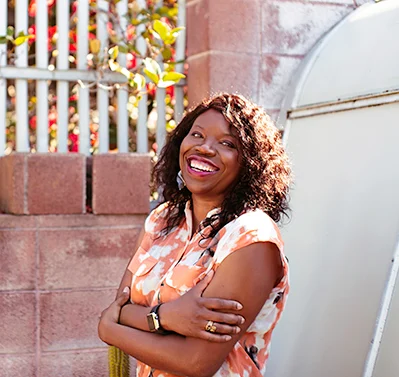

Image by S.H. Cowell Foundation
This summer, Studio O kicked off an exciting new partnership with the S.H. Cowell Foundation and its grantees to co-develop an approach to impact measurement that is hyper-local, context-specific, and values-aligned. The work also includes synthesizing best practices in trust-centered, place-based philanthropy to support both internal learning and broader field-building. In a time where many communities are navigating collapsing systems, we see great potential in helping to shape a nimble framework that is driven by those on the front lines and works to build stronger connections between them. Stay tuned for future updates. Learn more about the foundation here.

Image by Liz Ogbu
As part of their Graham Foundation–supported research project, Engaging Grief and Healing in Design, Liz and collaborator Christine Gaspar have undertaken case study research over the past year, including a trip to Washington, D.C. earlier this summer. This phase of their research has focused on museums and cultural spaces that tell our national stories. In particular, they’ve been analyzing how these places accommodate narratives of loss and support the grief connected to those narratives. It’s an area of examination that has taken on new importance given the current political climate. Liz and Christine are continuing to synthesize their research and in the next phase of the work, will be writing about their insights and recommendations for incorporating more capacity to support grieving and healing within design practice. Learn more about the research project here.

Image by PBS Western Reserve
In previous newsletters, we’ve shared about Studio O’s ongoing work on the Reconnecting our Community Initiative, an effort to honor the Black neighborhood displaced by the Akron Innerbelt and root a future vision in healing. This July, Liz moderated a panel with planning team members Siqi Zhu (Sasaki) and Mordecai Cargill (ThirdSpace Action Lab), alongside Esther Thomas (the City of Akron’s Director of Diversity, Equity, and Inclusion). With the Sasaki-led master planning effort set to wrap up later this fall, the conversation offered a chance to discuss the history and how it’s framing the approach to redevelopment. Watch the recording here.
In case you want to explore the ideas that underpin our work further, you can always view previous newsletters, find more media and more resources on the website!
Sign up for our mailing list to stay up to date with Liz and Studio O
Privacy Policy - COPYRIGHT LIZ OBGU / STUDIO O 2023-2026


Before you go… If this conversation resonated with you, I’d love to continue it.
Holding Space is an occasional newsletter exploring design, justice, grief, healing, and the work of creating possibility.


